Showing posts with label Revision. Show all posts

Monday, 14 May 2012

Marking Criteria

Level 1
Explanation/analysis/argument (0-7 marks)
  • Shows minimal understanding of the task
  • Minimal knowledge and understanding of institutional/audience practices – general opinions or assertions predominate
  • Minimal argument evident, with little reference to case study material
  • Of minimal relevance to set question or a very brief response
Use of examples (0-7 marks)
  • Offers minimal use of case study material
  • Offers a limited range of or inappropriate examples
  • Offers examples of minimal relevance to set question
Use of terminology (0-3 marks)
  • Minimal or frequently inaccurate use of appropriate terminology
Level 2
Explanation/analysis/argument (8-11 marks)
  • Shows basic understanding of the task
  • Basic knowledge and understanding of institutional/audience practices – factual knowledge will have some accuracy
  • Basic argument evident, with some reference to case study material
  • Some relevance to set question
Use of examples (8-11 marks)
  • Offers some evidence from case study material
  • Offers a partial range of examples from case study and own experience
  • Offers examples of some relevance to the set question
Use of terminology (4-5 marks)
  • Some terminology used, although there may be some inaccuracies
Level 3
Explanation/analysis/argument (12-15 marks)
  • Shows proficient understanding of the task
  • Proficient knowledge and understanding of institutional/audience practices – factual knowledge is mostly
  • Some developed argument, supported by reference to case study material
  • Mostly relevant to set question
Use of examples (12-15 marks)
  • Offers consistent evidence from case study material
  • Offers a range of examples, in some detail, from case study and own experience
  • Offers examples which are mostly relevant to the set question
Use of terminology (6-7 marks)
  • Use of terminology is mostly accurate
Level 4
Explanation/analysis/argument (16-20 marks)
  • Shows excellent understanding of the task
  • Excellent knowledge and understanding of institutional/audience practices – factual knowledge is relevant and accurate
  • A clear and developed argument, substantiated by detailed reference to case study material
  • Clearly relevant to set question
Use of examples (16-20 marks)
  • Offers frequent evidence from case study material – award marks to reflect the range and appropriateness of examples
  • Offers a full range of detailed examples from case study and own experience
  • Offers examples which are clearly relevant to the set question
Use of terminology (8-10 marks)
  • Use of terminology is relevant and accurate

Wednesday, 9 May 2012

Terminology Quiz to apply to your study

Convergence
-Coming together of multimedia digital technologies allowing audio, video, graphics, games and animation (eg iphone)
or
- Coming together of institutions (eg EMI bought up by Sony & Universal)

Synergy
-The coming together of two media texts to benefit them both eg: a film and its soundtrack will be released

Conglomerate
-An international company with a wide and varied range of commercial interests

Globalisation
-The growing tendency of industrial and commercial companies to merge and operate on an international rather than regional basis

Vertical Intragration-The takeover of companies operating at different stages of the production/distribution/exchange - in musicopoly this let you operate 50% more efficiently

Horizontal Integration
-The merger of competing companies from the same line of business (ie if itunes & Spotify merged) and involved at the same level of activity

Major Record Label-
-They are the 'Big Three' music companies which are Sony/BMG, Universal and Warner Brothers

Subsidiary Label-
-A company controlled by a holding or parent company (ie Syco & Sony)

Independent Label
-Not connected to a major company (ie XL or Ninja Tune)

Niche Audience
-A targeting of a small but significant group of consumers with a media product directed specifically at their interests

Mainstream Audience
-The uncontroversial, generally accepted attitudes, beliefs and values of the majority population

Fans
-Someone who has a strong interest and belief in the band or artist

Prosumers 
-Audience as active participantants in the process of both PROducing and conSUMING of media texts

Consumption
-Buying/downloading/streaming/filesharing music, paying for live convert tickets etc

Web 2.0
-The second phase of the internet, where the focus shifts from people receiving information and services to people creating and sharing material (music 2.0 is related to this)

Download
-The practise of selecting and receiving digital information from an online source on a computer, as opposed to sending it by upload

Streaming
-A method of relaying data over a computer network as a steady continuous stream, allowing playback to proceed while subsequent data is being received

Peer to Peer
-The sharing of media material between two parties in an equal relationship

Piracy
-Distribution of media material that infringes copyright law

Portability / Miniaturisation
-The quality of being light enough to be carried (iphone & Djay app anyone?)

Sampling
-the technique of digitally encoding music or sound and reusing it as part of a composition or recording - you have done this with your mash ups

Artists and Repertoire (A&R)
-Is the division of a record label that is responsible for talent scouting and overseeing the artistic development of recording artists. It also acts as a liaison between artists and the record label. They use your followers/friends on social media now to make this judgement

Record Deal - Contract - Royalties
-A recording deal is a legal agreement between a record label and a recording artist or group, where the artist makes a record or series of records for the label to sell and promote

Distribution
-Promoting music and getting it into shops, on the radio and downloaded for payment

Plugging / Marketing
-The transmission of information about a media text to a target audience in such a way as to maximise its appeal to that audience

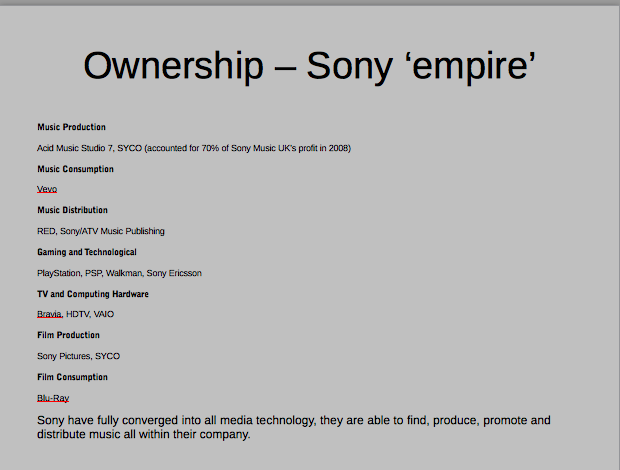
Major Label Case Study - Production/Distribution/Exchange Sony


Sunday, 25 March 2012

What significance does the development of digital media technology have for Audiences & Institutions?


Case Study Would I Lie to You? Syco & Sony & Visualisation of Music


Syco Entertainment
Syco Entertainment is a joint venture between Simon Cowell and Sony Music Entertainment.  
SYCO TV co-produces The X Factor and Got Talent. Local versions of The X Factor format air in over 45 countries and The X Factor (USA) is broadcast in 162 countries. Artists launched through The X Factor series globally have sold over 100 million records achieving more than 110 No 1's; 270 Top 10 and 510 Top 50 records. 


Case Study: Danger Mouse The Grey Album & Mash Ups

Grey Album 


The Grey Album is a mashup album by Danger Mouse, released in 2004. It uses an a cappella version of rapper Jay-Z's The Black Album and couples it with instrumentals created from a multitude of unauthorized samples from The BeatlesLP The Beatles (more commonly known as The White Album). The Grey Album gained notoriety due to the response by EMI in attempting to halt its distribution, despite the fact that both Jay-Z and Sir Paul McCartney said they felt fine with the project.


Production


Brian Burton (Danger Mouse) is quoted as saying:
"A lot of people just assume I took some Beatles and, you know, threw some Jay-Z on top of it or mixed it up or looped it around, but it's really a deconstruction. It's not an easy thing to do. I was obsessed with the whole project, that's all I was trying to do, see if I could do this. Once I got into it, I didn't think about anything but finishing it. I stuck to those two because I thought it would be more challenging and more fun and more of a statement to what you could do with sample alone. It is an art form. It is music. You can do different things, it doesn't have to be just what some people call stealing. It can be a lot more than that."[2]
Burton also commented at length on the creation of the Grey Album in the 2007 Danish documentary "Good Copy Bad Copy, A documentary about the current state of copyright and culture".[3]


Reception and Legacy

Professional ratings
Review scores
SourceRating
Allmusic4.5/5 stars [4]
The Boston Globe(favorable) [5]
Entertainment Weekly(A) [6]
NME(10/10) [7]
Pitchfork Media(7.7/10) [8]
Rolling Stone(favorable) [9]
Spin4.5/5 stars [10]
Stylus(C) [11]
Tiny Mix Tapes4/5 stars [12]
Village Voice(mixed) [13]

Danger Mouse is quoted as saying: "This wasn't supposed to happen... I just sent out a few tracks (and) now online stores are selling it and people are downloading it all over the place." Burton denied being the agent provocateur, saying it "was not my intent to breakcopyright laws. It was my intent to make an art project."[14]
Cultural critic Sam Howard-Spink observed that "The tale of The Grey Album and Grey Tuesday offers a rich case study for the examination of a wide variety of contemporary cultural issues within the context of the 'copyright wars' remix culture and the age of the digital network."[15]
Jonathan Zittrain, professor of Internet law at Harvard Law School, comments that "As a matter of pure legal doctrine, the Grey Tuesday protest is breaking the law, end of story. But copyright law was written with a particular form of industry in mind. The flourishing of information technology gives amateurs and homerecording artists powerful tools to build and share interesting, transformative, and socially valuable art drawn from pieces of popular cultures. There's no place to plug such an important cultural sea change into the current legal regime."[15]
On November 16, 2010, Jay-Z offered his thoughts on the album during an interview on NPR. "I think it was a really strong album. I champion any form of creativity, and that was a genius idea - to do it. And it sparked so many others like it..." [16]
McCartney, unlike most artists, welcomes the thought of being imitated because as the cliché goes, “Imitation is the highest form of flattery.”
His record company, EMI, held a different view. 

More on Grey Tuesday and EMI's legal response


Matthew Rimmer
THE GREY ALBUM: COPYRIGHT LAW AND
DIGITAL SAMPLING
Abstract
In the field of digital sampling, djs have shown a recent enthusiasm for ‘mash-ups’ — new compositions created by combining the rhythm tracks of one song and the vocal track of another. Most famously of all, DJ Danger Mouse remixed the vocals from Jay-Z’s The Black Album and the Beatles’ White Album and called his creation The Grey Album. The Grey Album poses a number of difficult issues regarding copyright law and digital sampling. Does such a ‘mash-up’ go beyond the de minimis use of a copyright work? Is The Grey Album protected by the defence of fair use under copyright law because it provides a
transformative use of copyright works? Can such remixes by compulsorily licensed? Does a ‘mash-up’ raise issues concerning the moral rights of attribution and integrity, which are recognised in Europe and Australia?


A commentator recently observed: ‘The most interesting and entertaining phenomena of the MP3 peer-to-peer is the availability of “mashes” — new compositions created by combining the rhythm tracks of one song and the vocal track of another.’ (Vaidhyanathan, 2004a: 104) The most famous example of a mash-up is The Grey Album. In 2003, DJ Danger Mouse — whose real name is Bruce Burton — remixed the vocals from Jay-Z’s The Black Album and the Beatles’ White Album and called his creation The Grey Album (Young, 2004). He released 3000 promotional copies of the album. The record company EMI, the owner of the rights to the sound recording of White Album, sent cease and desist letters to DJ Danger Mouse and stores such as Fat Beats and hiphop.com, demanding they destroy copies of the album and remove them from their websites. DJ Danger Mouse agreed to cease distribution of The Grey Album. He was quoted as saying, ‘This wasn’t supposed to happen … I just sent out a few tracks [and] now online stores are selling it and people are downloading it all over the place.’ (Reuters, 2004) He denies that he was an agent provocateur: ‘[It] was not my intent to break copyright laws. It was my intent to make an art project.’ (Moody, 2004)
On 24 February 2004, some 170 websites posted copies of The Grey Album on the internet in an act of protest and civil disobedience called ‘Grey Tuesday’. The organisers of the protest, Downhill Battle, declared online: ‘This first-of-itskind protest signals a refusal to let major label lawyers control what musicians can create and what the public can hear.’ (Downhill Battle, 2004) The group affirmed:
41. No. 114 — February 2005

‘We cannot allow these corporations to continue censoring art; we need commonsense reforms to copyright law that can make sampling legal and practical for artists.’ (Downhill Battle, 2004) A survey of the sites that hosted files during Grey Tuesday, and an analysis of filesharing activity on that day, reported that The Grey Album was the number one album in the United States on February 24 by a large
margin. The protestors boasted: ‘Danger Mouse moved more “units” than Norah Jones and Kanye West, with well over 100 000 copies downloaded.’ The album was also actively distributed on peer-to-peer networks, such as Kazaa and Soulseek.

Cultural commentators hailed such online activism as a symbol of democracy’ (Howard-Spink, 2004). In response, EMI and Sony/ATV Publishing instructed their lawyers to stop the distribution of The Grey Album on the internet. J. Christopher Jensen (2004), from the New York law firm Cowan, Liebowitz and Latman, warned the host websites of the album: ‘Any unauthorized distribution, reproduction, public performance, and/or other exploitation of The Grey Album will constitute, among other things, common
law copyright infringement/misappropriation, unfair competition, and unjust enrichment rendering you and anyone engaged with you in such acts liable for all of the remedies provided by relevant laws.’ He demanded that the sites ‘cease and desist from the actual or intended distribution, reproduction, public performance or other exploitation of The Grey Album and any other unauthorized uses of the Capitol
Recordings or any other sound recordings owned and/or controlled by Capitol’.